What makes a coloring page easy to finish
Five things that make a page easy to finish, and one drawing shown two ways.
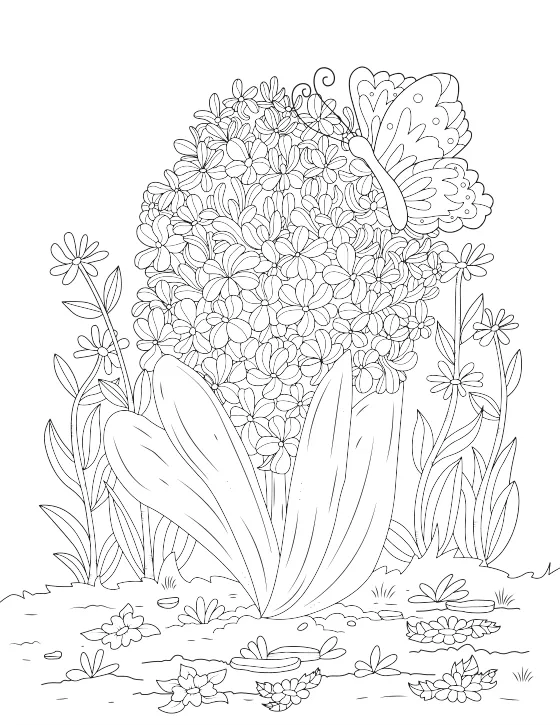
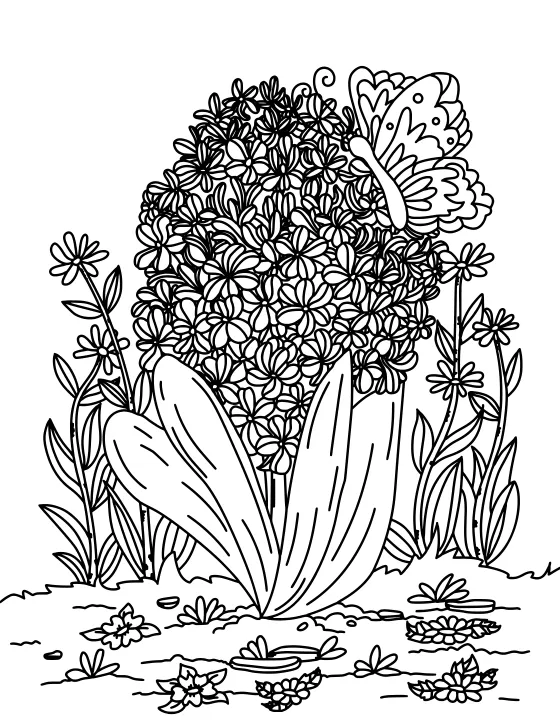
An easy coloring page has thick, dark lines, fewer tiny details, open space around the shapes, and a subject a grown-up would choose. Print it on plain letter paper and offer the same drawing in a bolder version too. Then the whole table can color the same picture.
What some sellers call "large print" comes down to the same few things. Here's what each one looks like on paper, and how to tell a page that is easy from a page that only looks easy.
Thick, dark lines
The line is the first thing anyone sees. A thin gray line fades into white paper. Before you can color a shape, you have to find where it starts and stops.
A thick black line does that work for you. The edge of every shape is plain from across the table, so the hand can start right away.
Check this on your own printer, not on the screen. A line that looks dark on a monitor can come out gray on a copier. If that happens, choose "Text," not "Photo," and turn off toner save.
Fewer tiny details
Details are where a page stalls. A flower packed with small petals, inside a page full of leaves, asks for a sharp point and a lot of patience. Some days that's welcome. Other days it's the reason a page gets pushed aside half done.
Fewer details doesn't mean a bare page. It means each shape is big enough to fill with an ordinary pencil without going over the line every few strokes.
Look for closed shapes, too. When a line stops short, there's no clear edge, and it's hard to know where one color should end. On a good easy page, every petal and every leaf is closed all the way around.
Here's a quick test. Could you color the smallest shape on the page with the side of a crayon? If not, the page is made for a long, quiet sit. That's fine, but it's not the page to start with.
Room to breathe
White space tells the eye where one thing ends and the next begins. A page packed from edge to edge can look like a wall of lines. Butterfly in a bed of flowers is a lovely page for someone who wants a long project, but it's not where most people should start.
A page with one big subject and room around it looks like something you can finish. That's the idea behind One Thing on the Page, a pack in the library with one subject, drawn big. Big butterfly is one butterfly over flowers. Sailboat is a boat, some waves, and a few clouds.
A grown-up subject
Easy should never mean childish. Cartoon animals with big eyes, smiling suns, and letters to trace all say the same thing: this was made for a child. An adult can tell in a second, and many will push the page away.
Pick subjects people lived with. Gardens, cats, sailboats, a cup of cocoa, a clothesline, a basket of apples. A real subject is also something to talk about, and that matters as much as the lines.
Plain letter paper, one side
Print on letter paper, the 8.5 by 11 inch sheet every office printer takes. Put one drawing on each sheet, printed on one side only, so nothing shows through from the back.
Let the drawing fill the sheet. A small picture in the middle of a big page shrinks every shape in it. Skip pages crowded with words, fancy borders, or a website's name in large type. The picture is the point.
Colored pencils work fine on plain copy paper. For markers, print on cardstock so they don't bleed through.
The same drawing, two ways
Here's the trouble with "easy" pages. The person who gets one knows it. If the table has a detailed page and a simple page, someone ends up with "the easy page," and everyone can see it.
Printing the same drawing two ways fixes that. Look at Hyacinth, shown above in Regular and Bold. Regular has every line and detail, for a long, quiet sit. Bold is the same drawing with thicker, darker lines and fewer tiny details, so it's easier to see and easier to finish. From across the table, they look like the same picture, because they are.
Staff pick the version that suits each person that day. Someone who wants Regular on Tuesday may want Bold on Friday. Choose by the person and the day, not once and for good. You can read more about how Regular and Bold work.
Then ask about the picture
A page is easier to start when there's something to talk about. Every Tablewell page has a Story Starter, one question to read aloud while people color.
The one under Hyacinth is "What's a smell that makes you think of spring?" Nobody can get it wrong. Read it once to the whole table, then go back to your own page. If someone wants to answer, they will.
Five questions before you print
Hold the page at arm's length and ask:
- Can I see every line clearly from here?
- Is the smallest shape big enough for an ordinary pencil?
- Is there white space around the main subject?
- Would a grown-up choose this picture?
- Is there a Bold version of the same drawing for anyone who wants one?
Five yeses, and you have an easy page. Four, and it may still be a good page, just not the first one to hand out.
Try it on your own printer
The best way to judge a page is to print it and put it on the table. The First Pack is six drawings with a Story Starter on each, free, with your organization's name on the cover. Print them, hand them out, and watch which ones get finished.
Free coloring pages for your activity calendar: tablewellpages.com/free