Low-cost activities that don't feel cheap
Fifteen ideas that cost little or nothing, and what coloring really costs per person.
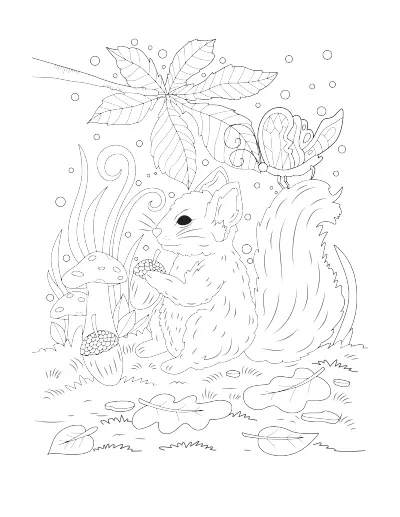
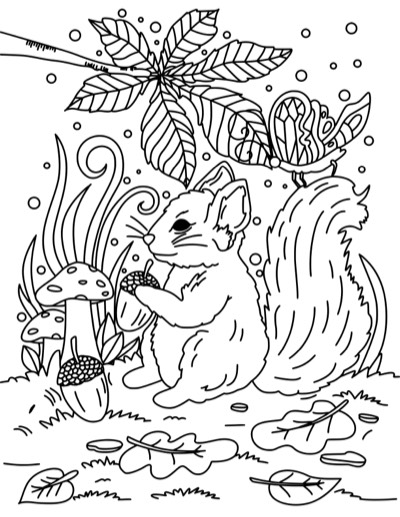
Low-cost activities that don't feel cheap are built on something real: a good question, a real thing to hold, a song someone asked for, a grown-up drawing. Here are fifteen that cost little or nothing, each with a version for someone who stays in their own room.
What makes an activity feel cheap usually isn't the price. It's materials made for children, a setup that looks thrown together, or a plan that treats grown-ups like a class. Every idea below avoids those three.
Fifteen ideas
A coloring hour with a question. Print one drawing in Regular and Bold, set out pencils, and read the Story Starter once. Squirrel and acorns, shown above, asks, "What did you save up for, and did you get it?" In a room: leave a few Bold pages and a pencil within reach.
One real thing to hold. Bring a single object that matches the day's drawing and pass it around. A crisp apple for Apple tree and baskets. A seed packet, a wooden spoon, a fishing reel. In a room: bring the object along on your visit and let them hold it while you talk.
Smell jars. Put a little cinnamon, coffee, vanilla, and orange peel from the kitchen into covered jars. Pass them around and guess. Check for allergies first. In a room: bring two jars and ask which one smells like a holiday.
Songs by request. Ask everyone for one song from when they were young, and play the list. Hand out spoons or jars of rice to tap along. In a room: play one requested song and ask where they were the first time they heard it.
The newspaper, read aloud. Read the headlines, the weather, the comics, and the prices in the grocery ads. Let the table argue about what things cost. In a room: read the page they pick.
Ask the expert. Everyone knows how to do something. Ask one person each week to explain it: how to make a pie crust, change a tire, plant tomatoes, fold a flag. In a room: ask the question one to one, and write down the answer for them to keep.
A windowsill garden. Plant herbs or flower seeds in paper cups or egg cartons, and set them in a sunny window. Water and check on them together each week. In a room: give them one cup of their own to look after.
The bird window. Hang a feeder outside a window you can see from the activity room. Keep a pair of binoculars and a library book about birds nearby. In a room: if the window faces a tree, a small feeder there works too.
The seed catalog. Garden catalogs often arrive free in the mail in winter. Page through them together and choose what you'd plant if you had a yard. In a room: leave the catalog with a sticky note on a page to start with.
Where we've been. Hang a large printed map and mark the places people have lived, worked, or visited. Each pin is a story. In a room: bring a small printed map of their home state and ask them to point out the places that matter.
Write a letter. Write notes together to a school class, a family member, or the kitchen staff. Someone who would rather talk can dictate. In a room: offer to write a letter for them, in their words.
Butter in a jar. Pour heavy cream into small jars with tight lids and pass them around to shake. In time it turns to butter. Spread it on crackers, if diets allow. In a room: bring one jar and shake it together.
Cards and dominoes. Use large-print cards or big dominoes, and play a simple game everyone knows. Keep score loosely, or not at all. In a room: a hand of cards and a game for two.
The library cart. Ask your public library about lending to your location: large-print books, audiobooks, picture books about places, and old magazines. In a room: deliver one book chosen for that person.
A visit from outside. School choirs, scout groups, and music students are often glad to have somewhere to perform. Invite one, and ask them to stay for ten minutes of talk afterward. In a room: ask one singer to stop by a doorway for a song.
The coloring math
Coloring can be one of the lowest-cost activities on the calendar, if you count it the right way.
A coloring book is one copy for one person. One coloring book for each of 40 people runs about $250 to $400 a year, and each page gets colored once. Next year, you buy the books again.
A license works differently. Tablewell is $149 a year per location. That covers unlimited copies of every drawing, in Regular and Bold, for everyone you serve. For 40 people, that's about 31 cents each a month. New pages arrive every month.
The paper is copy paper you already have. Pencils last for many activities.
Then there's your time. If you spend 30 minutes a week hunting for pages, that's 26 hours a year. Those hours could go into every other idea on this list.
How to make low cost feel like care
The difference between cheap and thoughtful is mostly in the setup.
- Use real things. Real mugs, real cloth napkins, a real vase. Leave the cartoon paper plates in the closet.
- Set the table before people arrive. A ready table says "we planned this for you."
- Call the activity by its subject. "Seed catalogs and spring plans" sounds better on a calendar than "Free time."
- Ask about, not whether. Questions about tastes and places have no wrong answer.
Two more questions to keep handy. Mason jar bouquet asks, "What went into jars at your house: jam, pickles, or flowers?" Strawberries on the fence asks, "Strawberries: on shortcake, with cream, or straight off the plant?" Its follow-up is "What was the first job that put money in your pocket?" Both fit an afternoon of making do.
Try the coloring hour free
The First Pack is six drawings with a Story Starter on each, free, with your organization's name on the cover. It's enough for your first coloring hour this week. For the rest of your activity calendar, see ideas for activity directors.
Free coloring pages for your activity calendar: tablewellpages.com/free